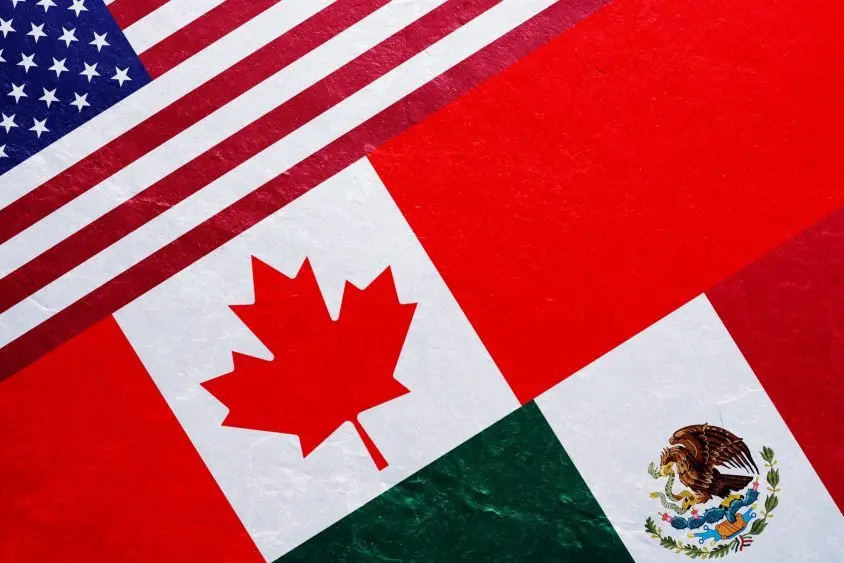
As Washington moves closer to the mandatory review of the United States-Mexico-Canada Agreement this summer, farm and food groups are mounting an organized defense of the trade pact — warning that unraveling it would destabilize North America’s integrated agricultural economy at a time when producers are already facing financial strain.
The Agricultural Coalition for the USMCA, a broad alliance of farm organizations, exporters and supply chain groups, this week released a new economic analysis aimed squarely at policymakers weighing the agreement’s future. Leaders from the three countries are required to begin the renewal process by July under the pact’s six-year joint review mechanism, part of a 16-year sunset structure written into the agreement when it replaced the North American Free Trade Agreement in 2020.
For agriculture, the stakes are unusually high.
Krista Swanson, chief economist for the National Corn Growers Association and co-author of the report, said the agreement has delivered measurable gains for U.S. producers since taking effect.
“Without USMCA, U.S. agriculture would lose a critical source of stability, face reduced market access and have fewer opportunities at a time when rural America can least afford disruption,” Swanson said.
“In contrast, renewing the agreement reinforces stability, increases market access and expands opportunity, building on the positive impacts that USMCA has delivered for farmers and consumers and reinforcing its lasting contribution to growers and rural America,” she said. “The positive impact for farmers and consumers alike is what makes USMCA a signature achievement of President Trump’s first term. Renewing the agreement will solidify the president’s legacy through the continued contribution to growers and rural America.”
U.S. agricultural exports to Canada and Mexico have increased by $20 billion since implementation, reaching $60 billion in 2024, along with $1.2 billion in seafood exports. That represents 47% growth — far outpacing the 18% increase in U.S. agricultural exports to the rest of the world during the same period.
But the coalition’s message goes beyond trade values.
Using a regional economic modeling tool, the study found that agricultural and seafood exports to Canada and Mexico generated $149 billion in total economic contribution to the U.S. economy. USMCA-related trade supports nearly half a million full-time equivalent jobs and $36 billion in wages. For every $1 in agricultural exports under the agreement, an additional $2.45 in economic activity is supported across the broader U.S. economy.
In total, USMCA-linked trade supports $64 billion in U.S. GDP and $13 billion in tax revenue.
Those figures come as farmers confront tightening margins driven by lower commodity prices, elevated input costs and higher interest rates. While global export markets have shown volatility, Mexico and Canada have provided relative stability — particularly for corn, dairy, fresh produce and processed food products.
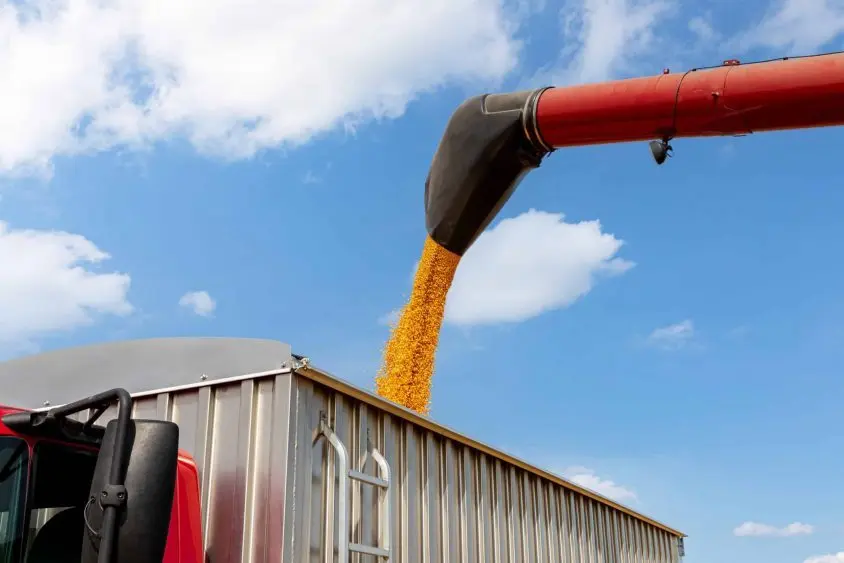
Mexico remains the top export market for U.S. corn, and Canada and Mexico together account for nearly half of U.S. dairy exports.
Swanson said that stability matters because farmers make multi-year investment decisions based on predictable market access and enforceable trade rules.
While farm groups are defending the agreement’s framework, they are also pressing for targeted fixes during the review.
Shawna Morris, executive vice president of trade policy for the National Milk Producers Federation and the U.S. Dairy Export Council, said USMCA accounted for $3.6 billion in dairy exports in 2024 — 44% of total U.S. dairy exports.
“USMCA is an extremely strong agreement, but it’s not perfect,” Morris said. “The USMCA review offers an unmissable opportunity to make some targeted enhancements so the agreement can live up to its full intended potential. Most notably, Canada still has a lot of work to do to hold up its end of the bargain on dairy. For years now, Canada’s been playing games with access to its dairy tariff rate quotas, and that’s resulted in shortfalls in the export access the U.S. negotiated for.”
Under USMCA, Canada agreed to create tariff rate quotas allowing specified volumes of U.S. dairy products to enter at lower tariff levels. Morris said Canada’s allocation system largely directs those quotas to domestic processors, limiting practical access for U.S. exporters and preventing full utilization of negotiated volumes.
The U.S. has already pursued dispute settlement proceedings against Canada under USMCA, winning an initial ruling, though industry groups argue implementation gaps remain.
Morris emphasized that U.S. dairy is not seeking to dismantle Canada’s supply management system. Rather, she said, the industry wants Canada to “hold up its end of the bargain” by ensuring the access negotiated under USMCA functions as intended.
Issues held over from initial negotiations are also seen with America’s southern partner.
“Although Mexico has been a strong partner in USMCA six years into the agreement, it still hasn’t implemented some of its commitments on preserving access for common cheese names,” Morris said.
Where are biotech, ethanol and science-based standards seen?
Corn growers are also looking to the review to reinforce science-based trade disciplines.
Nancy Martinez, director of policy at the National Corn Growers Association, said the group is seeking clarification in the agreement to ensure Mexico cannot cite non-scientific rationales — such as cultural concerns — to restrict biotechnology.
The issue became central during a high-profile dispute over Mexico’s biotech corn policies. U.S. industry groups argue that predictable, science-based standards are essential for maintaining long-term investment in seed innovation and production.
Ethanol is another focus. Mexico currently maintains an ethanol blending rate of about 5.8% and restricts blending in its three largest metropolitan areas. Martinez said corn growers are encouraging the use of USMCA’s working group structures to provide technical assistance and encourage expanded ethanol adoption, which would boost U.S. exports while advancing environmental objectives.
How does fresh produce come into play with the trilateral argument?
If dairy highlights enforcement tensions and corn underscores regulatory clarity, fresh produce illustrates why many groups are wary of any shift away from the trilateral structure of USMCA.
Alexis Taylor, chief global policy officer for the International Fresh Produce Association, said fresh fruits and vegetables move through an integrated North American supply chain that often crosses borders multiple times between growing, packing, processing and distribution.
In 2024, $2.81 billion in fresh fruit and nearly $2.5 billion in fresh vegetables were exported to Canada and Mexico. Since USMCA’s enactment, U.S. fresh fruit export values have increased by 34% and vegetable exports by 14%.
“These outcomes reflect the value of a trade framework that provides certainty for perishable products that must move quickly and predictably across the North American continent,” Taylor said. “This shows the tangible value of market access provided by USMCA to our produce growers. USMCA supports one of the most integrated fresh produce markets in the world, and Canada and Mexico remain the top two export markets for U.S. fresh fruit and vegetables, underscoring the importance of that strong North American trading bloc.”
Taylor said produce trade depends on speed and predictability. Because fruits and vegetables are highly perishable, delays or regulatory fragmentation can quickly disrupt supply chains and raise consumer costs.
Her comments come amid broader debate in Washington over whether trade relationships should be structured bilaterally rather than trilaterally. Industry groups argue that breaking the agreement into separate U.S.-Mexico and U.S.-Canada deals would undermine the integrated system that currently allows products to move efficiently across the continent.
What happens if USMCA is not renewed?
The coalition’s study did not model a non-renewal scenario. But Swanson said the implications are clear: removing the agreement’s framework would introduce instability at a moment when the farm economy is already under pressure.
Without renewal, tariffs could eventually snap back to pre-USMCA levels, depending on how the process unfolds. Even the uncertainty surrounding negotiations could influence planting decisions, capital investments and forward contracting in commodity markets that depend heavily on export demand.
Farm groups frequently describe USMCA as one of the most significant agricultural trade achievements of the last decade. The agreement was renegotiated during President Trump’s first term, with broad support from major commodity organizations.
Now, as policymakers prepare for the review process, agriculture is sending a clear message: preserve the trilateral framework, strengthen enforcement where needed and maintain science-based standards — but avoid destabilizing a trade relationship that underpins nearly $150 billion in economic activity and hundreds of thousands of American jobs.
For rural communities navigating thin margins and volatile global markets, coalition leaders argue, the stability provided by USMCA is not theoretical — it is foundational.