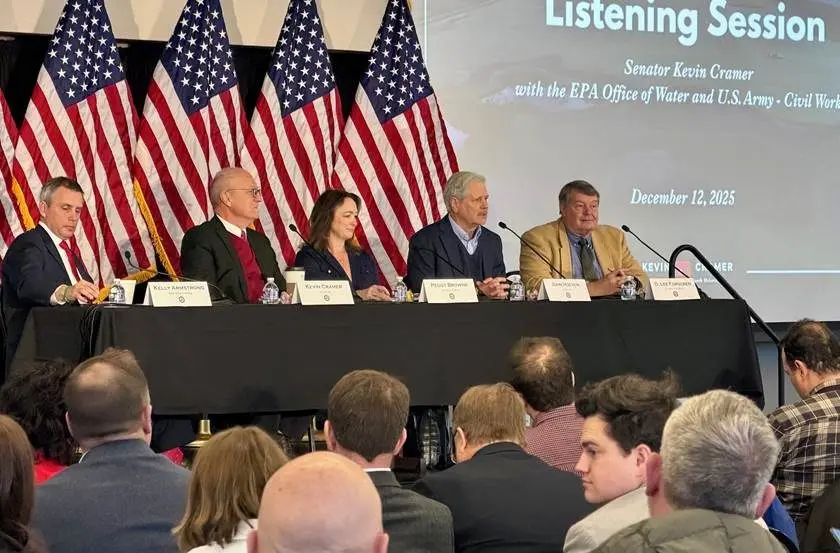
BISMARCK, ND — On Friday, Senator Kevin Cramer (R-ND) hosted a first-in-the-nation listening session on the proposed Waters of the United States, or WOTUS, rule being proposed by the Environmental Protection Agency.
“North Dakotans know the impacts of a good WOTUS rule better than anyone,” said Cramer. “This listening session is a great opportunity for North Dakotans to help craft the final rule and bring their feedback directly to EPA and Army Corps officials. I encourage North Dakotans to make their voices heard at the listening session and by submitting public comments throughout the rulemaking process.”
Cramer has been a longtime supporter of a clear, durable WOTUS rule throughout his time in Congress. In March, he joined EPA at its announcement of the pre-rulemaking guidance. At the event, he highlighted the North Dakota farmers, ranchers, and landowners who “have always managed their water with the same respect as their land.” The newly proposed rule by EPA clarifies definitions after the landmark Supreme Court ruling in Sackett v. EPA limited the federal government’s jurisdiction over water according to the Clean Water Act.
Senator Cramer was joined by Senator John Hoeven (R-ND), Environmental Protection Agency (EPA) Assistant Administrator for Water Jess Kramer, North Dakota Governor Kelly Armstrong and more stakeholders for the event.
“Considering the tremendous impact the Obama and Biden-era WOTUS rules would have had on our state’s farmers, ranchers, energy producers and construction industry, it makes sense for the EPA to hold its first listening session on this new rule right here in North Dakota,” said Senator Hoeven. “This is about protecting private property rights, pushing back on federal overreach and ensuring the EPA complies with the law. That means restricting WOTUS to navigable waters and not allowing federal authority to be expanded to areas like ditches, intermittent waters and other water resources that fall under the authority of state and local governments. That’s exactly what I’ve been working to achieve since I first led the effort to defund the expansion of WOTUS under the Obama administration.”
“The Biden-era WOTUS rule was an existential crisis for North Dakota. It represented massive federal overreach that would have been catastrophic for North Dakota’s farmers and ranchers, energy producers and small businesses. That’s why our state has been the tip of the spear in pushing back on previous rules that would have harmed our state,” Governor Armstrong said. “The Trump administration’s proposed rule protects our water resources while protecting and preserving private property rights. Under this new rule, farmers and ranchers won’t have to worry about asking the federal government for permission before they can plant a soybean crop or run cows on their pasture. It’s great to be up here knowing that North Dakota voices will actually be heard.”
North Dakota and 23 other states successfully sued the EPA and Army Corps in 2023 over the Biden administration’s overreaching WOTUS rule, convincing a federal judge to block rule from being implemented. The U.S. Supreme Court subsequently found in Sackett v. EPA that the Biden EPA’s interpretation of WOTUS was inconsistent with the Clean Water Act and would impinge on states’ traditional authority to regulate land and water.
North Dakota Farm Bureau (NDFB) President Val Wagner spoke at the Waters of the United States listening session on Friday, stressing the importance of a clear and limited WOTUS definition. “Past interpretations of WOTUS treated everyday puddles and sloughs as federally regulated waters, adding stress and instability to farmers’ daily decisions,” said Wagner.
She praised the proposed rule for narrowing federal oversight to waters with continuous surface connections while excluding seasonal puddles, sloughs, isolated wetlands, groundwater, and agricultural ditches. Wagner highlighted that the rule shifts the burden of proof to the federal government, allowing farmers to manage their land without unnecessary interference.
“The proposed rule is legally durable and faithfully implements the Supreme Court’s recent Sackett decision,” said Wagner. “It narrows the scope of federal oversight to waters that have continuous surface connections.”
Wagner also emphasized the need for practical implementation, urging regulators to ensure the rule is workable on the ground. “Farmers and ranchers are the best stewards of the land—they simply need the freedom to do their jobs,” she said.
North Dakota Stockmen’s Association (NDSA) Executive Vice President Julie Ellingson, a fourth-generation cattle rancher, testified as well at Friday’s WOTUS listening session where she applauded the trajectory of the rule as a much clearer, appropriate and durable product than previous renditions that have caused uncertainty, project delays and unnecessary costs for cattle producers.
“With the proposed rule, we have come a long way in addressing cattlemen’s and cattlewomen’s concerns about WOTUS,” she said.
Ellingson pointed out that, collectively, cattle producers are the nation’s largest land manager, grazing on nearly a third of the continental landmass. “So, if we are talking about direct impacts of expanded regulatory authority over water features, ranchers are the tip of the spear,” she said. “In a time when regulatory changes pressure-test our producers daily, a legally and practically narrow WOTUS definition is critical to ensuring that our industry can continue to maintain America’s grassland ecosytems, natural water filters and wildlife habitat.”
The NDSA strongly supports the agencies’ proposed two-part test for the jurisdictional tributary category, which requires the existence of both continuous surface flow and physical indicators. “We additionally support the explicit exclusion of ephemeral features, ditches, subsurface drainage, stock ponds and waste treatment systems,” Ellingson added.
Ellingson said the proposed is a significant improvement over earlier versions. “It is leap years’ ahead in recognizing private property rights and state’s rights and, hopefully, will bring forth the clarity cattle producers and others have been seeking for decades.”
The listening session was livestreamed on Cramer’s YouTube page. The WOTUS rulemaking public comment page can be found here; the public comment period ends on Jan. 5.