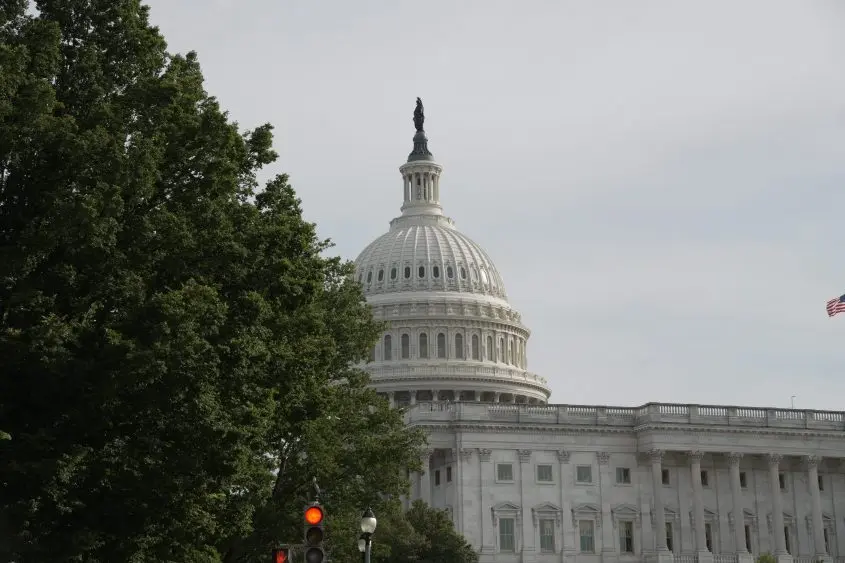
(WASHINGTON D.C.) – On Monday, the United States Senate voted 60 to 40 to end the longest government shutdown in U.S. history and extend current funding through the end of January 2026 via a Continuing Resolution. Attached to the CR was a package of appropriation bills, including: Military Construction/Veterans Affairs, Agriculture, and the Legislative Branch.
U.S. Senate Committee on Agriculture, Nutrition, and Forestry Chairman John Boozman (R-AR) welcomed passage of a measure to reopen the government that funds the U.S. Department of Agriculture for Fiscal Year 2026 and includes the extension of farm programs and authorities not covered in the One Big Beautiful Bill that were set to expire at the end of the year, in addition to an extension of federal grain inspection activities.
“Ending the government shutdown ensures critical USDA services resume so vulnerable families no longer experience disruptions to nutrition benefits, farmers can access the programs and personnel they rely on to keep their operations running efficiently and disaster assistance is delivered,” Boozman said. “We advanced long-overdue farm bill policy improvements in the One Big Beautiful Bill, including enhanced risk management tools farmers have been calling for, and we’re continuing work to reauthorize other key initiatives. Extending the farm bill and the U.S. Grain Standards Act gives us more time to finalize these programs essential to farmers, ranchers and rural America.”
Senator John Hoeven (R-ND), chairman of the Senate Agriculture Appropriations Committee, issued a statement after the passage of the legislation passing the Fiscal Year (FY) 2026 agriculture funding and to reopen the government.
“We advanced this year’s agriculture funding legislation through regular order, showing that we can support our priorities and find savings to reduce the debt and deficit, while securing bipartisan support both in committee and on the Senate floor. That’s the right way to approach our appropriations work, and this agreement to re-open government helps us get that process moving again,” said Senator Hoeven. “Importantly, we worked to ensure our ag funding legislation supports the innovative research being conducted by NDSU, Grand Farm and their partners. At the same time, this bill supports better access to credit and the services our producers rely on at FSA. This is important not only as harvest wraps up, but as we work to advance an ag assistance bill to provide a bridge to help producers until the new reference prices come into effect.”
Senator Kevin Cramer (R-ND) applauded the news as well. In a statement, he said in part that “the passage of this package is big, it’s a win for our veterans, law enforcement officers, farmers, ranchers, and manufacturers, as well as every American across the nation.” On agriculture specifically, Senator Cramer added that “the bill supports North Dakota’s farmers and ranchers through programmatic funding increases by prohibiting the closure of FSA county offices, which we know are critical to servicing our farmers and ranchers every day. This vote really reflects the Senate’s commitment to those who serve, those who produce, and keep our nation strong. I hope the House will act swiftly to get this across the finish line and reopen the government by mid-week.”
Senator Roger Marshall, M.D. (R-Kansas), issued the following statement after the CR vote saying “after 41 days of Senate Democrats holding the government hostage for political leverage, I’m glad they finally came to their senses and voted to reopen it,” said Senator Marshall. “Alongside passing a clean CR, we advanced three appropriations bills that deliver real wins for Kansas agriculture, our military, and our veteran communities. Now that the political games are over, I look forward to getting back to work and continuing to deliver on the America First agenda.”
Numerous Senate Democrats had been in opposition to passing a Continuing Resolution without some guarantees on Affordable Care Act tax credit extensions. However, eight Democrats broke party lines to vote to reopen the government. The bill now heads back to the House for final approval to reopen the Federal Government. CNN is reporting that the House plans to vote on the Senate-passed bill to reopen the federal government as early as 4 p.m. on Wednesday, according to a notice from Majority Whip Tom Emmer. The notice forecasts multiple votes that day.
Some of the agriculture pieces passed with the CR included:
- Fully funds the National Bio and Agro-Defense Facility to support the protection of the U.S. agricultural economy and maintain our position as a global leader in animal health, biodefense, and biosecurity.
- $1 million to continue the Cattle Contract Library Pilot Program and maintain funding for enforcement activities related to the Packers and Stockyards Act.
- Helps ensure producer access to credit, providing sufficient funding to meet demand for the Farm Service Agency’s (FSA) direct and guaranteed operating and ownership loans.
- Continues the prohibition on FSA county office closures.
- Gives ranchers the necessary resources to comply with the Animal and Plant Health Inspection Service’s (APHIS) electronic identification (EID) tag requirement.
- This follows Senator Hoeven’s efforts last year to secure an additional 3 million EID tags to prevent an unfunded mandate from being imposed on U.S. ranchers.
- Provides $500,000 for blackbird depredation in the Northern Great Plains.
- Empowers APHIS to protect the nation’s livestock against diseases, including avian influenza and chronic wasting disease (CWD), while supporting continued CWD research at ARS.
- Nearly $2.5 million for the Agricultural Risk Policy Center at North Dakota State University (NDSU), bringing the total funding Hoeven has secured for this initiative to nearly $6.5 million since FY2024.
- $5 million for the AgTech Cooperative Agreement between Grand Farm, NDSU and the Agricultural Research Service (ARS). This includes $2 million to establish an ARS work site at Grand Farm.
- $3 million for continued renovations at the Edward T. Schafer Agricultural Research Center in Fargo.
- Maintains and strengthens a wide range of agriculture research conducted in North Dakota, funded through ARS and the National Institute of Food and Agriculture (NIFA), supporting better yields and disease resistance for crops like wheat, soybeans, barley, oats, potatoes, pulse crops and canola, among others.
- Includes a $15 million increase for the State Meat and Poultry Inspection and Cooperative Interstate Shipment Programs, as requested by the Administration.
- Provides additional resources to improve the tracking system of foreign-owned land and maintains the Secretary of Agriculture’s position on the Committee on Foreign Investment in the U.S. to protect our farmlands from being bought by our adversaries.
- $1.7 billion for affordable housing rental assistance for low-income families and seniors in rural communities.
- $1 billion for Single-Family Housing direct loans and $25 billion in for the guaranteed Single-Family Housing loans.
- $1.4 billion to prioritize revitalization of aging water and wastewater infrastructure through grants and loans.
- $1.8 billion in grants and loans for rural business and industry programs to promote economic growth.
- International Food Assistance: $1.2 billion for Food for Peace Title II Grants and $240 million for the McGovern-Dole International Food for Education program to strengthen export markets and provide emergency food assistance.
- New World Screwworm Report: Not later than 30 days after enactment of this act, the Secretary shall submit to Congress a report on the New World Screwworm domestic readiness and response initiative of APHIS, with a particular focus on:
- (1) domestic readiness, including the construction of a domestic production facility in the event of a threat of a domestic outbreak; and exploring partnerships with States and industry with respect to that construction and other domestic preparedness efforts;
- (2) sterile fly production technology and other eradication tools and technologies; and
- (3) the benefits of and barriers, including timelines and costs, to enhanced domestic, as compared to international, sterile fly production.