AMES, Iowa — Milk is one of the most widely consumed agricultural products globally, and its production trends have significant economic, nutritional, and environmental implications. In recent years, many countries have expanded their dairy sectors with increased investment. In the United States, production topped prior-year levels by 4.1 percent in July, 3.4 percent in August, 3.8 percent in September, and 3.7 percent in October, marking the highest four-month average year-over-year increase since 2012. In Europe, milk production got off to a slow start in 2025, with milk collections from January through August closely matching those of the prior year. But growth accelerated this fall. Milk collections topped 2024 by 4.2 percent in September and an astounding 5.3 percent in October. When the United Kingdom is included in the mix, October milk production soars 5.5 percent year over year. As global milk production continues to rise, consumers and retailers alike are asking a key question: How will this affect the price of milk on grocery store shelves?
In November, month-over-month global food prices declined for the third consecutive month, according to the Food and Agriculture Organization (FAO). The dairy index has declined every month for the past five months, after nearing a record level in June 2025. In November, the dairy index was at its lowest point since September 2024.
How Increased Milk Production Affects US Grocery Store Prices?
While global food prices ease, dynamics have been slightly different in the United States. For example, U.S. Bureau of Labor Statistics data showed butter prices averaged $4.787/lb. in September, down 4.3 percent from their all-time high set in September 2024.
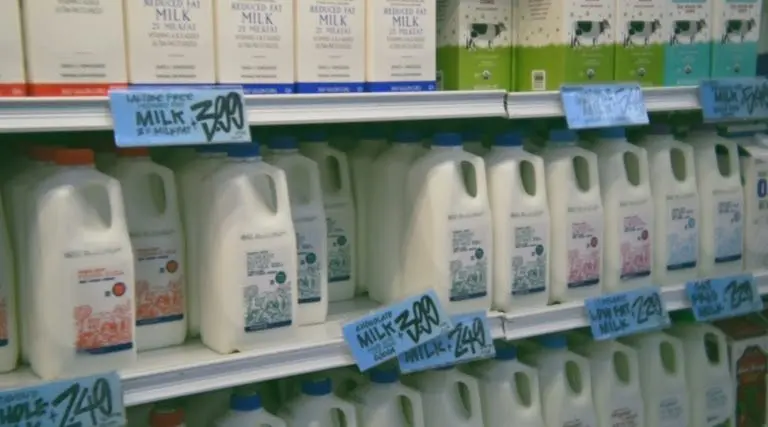
On the other hand, the average price of one pound of Cheddar reached an all-time high of $6.123/lb. in August, and sat at $6.049 in September, still historically high. While the price of a gallon of whole milk was rangebound from September 2024 to September 2025, ranging between $4.021 and $4.171 on average. The supply side is winning in terms of market direction, and until milk production slows in major exporting regions, the dairy balance sheet will remain burdened with product, keeping prices depressed.
More global supply does not consistently lower local prices directly, but it often exerts downward pressure. Here are key factors that shape the final price consumers pay:
As a rule, the relationship between supply and demand dynamics generally sees global milk production increase faster than demand, and wholesale milk prices tend to decline. Grocery store prices may follow, although typically at a slower rate, as retailers adjust gradually.
Processing and packaging costs are a major cost of milk. Even if farm-gate milk becomes cheaper, the price on store shelves depends heavily on processing, packaging, and distribution costs. These can fluctuate in response to changes in fuel prices, labor costs, and inflation.
With international trade and market competition, countries that import milk or dairy products will see lower prices with global supply increases. Although the US is an exporter, as an export-heavy country, we will reduce prices when international competition intensifies.
Local retailer pricing strategies are dynamic, stores often treat milk as a “loss leader”—a product priced low to attract shoppers. Increased global supply can give retailers more flexibility to push prices down in competitive markets.
What does this mean for price trends in the near future?
- Moderate downward pressure on prices: If global production continues rising steadily. At the same time, demand grows more slowly, and consumers may enjoy more stable or slightly lower milk prices.
- Regional variation: Some areas may still see higher prices due to transportation costs, local shortages, or policy restrictions.
- Specialty dairy products may behave differently: Organic, lactose-free, or niche-brand milk often follows its own pricing dynamics due to certification, higher production costs, or branding.
Rising milk production is generally positive for global food security, offering greater availability and often lower prices. However, impacts on grocery store milk prices vary by region and depend on a complex mix of economic and policy factors. The local production and processing along the I-29 corridor help moderate price fluctuations.
For consumers, the good news is that in many markets, increased worldwide production tends to create price stability—and sometimes modest declines—even during periods of inflation. For farmers, the challenge is balancing production with sustainable pricing to maintain profitability.